
How to Measure Your Giant Pumpkin
The Over-The-Top (OTT) method is the standard way to estimate your pumpkin's weight — all you need is a tape measure and a friend.
What is OTT?
OTT stands for "Over The Top" — the method growers have used for decades to estimate a pumpkin's weight before it hits a scale. Three tape measurements capture the pumpkin's size in three dimensions, and you add them together to get your OTT number. Look it up on a chart or run it through a formula and you've got an estimated weight. Most pumpkins come in within a few percent of the estimate, but every pumpkin carries differently — wall thickness, density, and shape all play a role. In the hobby, this is known as going "to chart," or being "over chart" or "under chart."
Tip: Always measure to the conservative side. It's much better to show up at the weigh-off expecting 1,200 lbs and finding out you've got 1,350 than the other way around. Surprise weight is the best kind of weight.
Why use OTT?
You can't exactly roll a 1,500-pound pumpkin onto a bathroom scale. OTT gives you a reliable estimate without any heavy lifting.
More accurate than circumference alone
Circumference only captures one dimension. OTT measures three, giving you a much better picture of the pumpkin's overall size and a tighter weight estimate — typically within 5% of actual weight.
Track growth over the season
Measuring daily or weekly lets you track your pumpkin's growth rate in pounds per day. You'll know exactly when your pumpkin is accelerating, plateauing, or slowing down.
The competition standard
The GPC (Great Pumpkin Commonwealth) publishes official OTT-to-weight charts updated with data from thousands of weigh-offs. It's the universal language of giant pumpkin growing.
Dead simple to do
No special equipment, no math degree, no crane required. A soft tape measure and a helper is all you need. The whole process takes about two minutes.
What you'll need
Keep it simple — you probably already have everything.
Soft tape measure
A flexible cloth or vinyl tape, at least 20 feet (6m) long. The kind a tailor would use, just longer. If you don't have one, a length of string and a regular tape measure works too.
A helper
You'll want someone to hold the other end of the tape. You can do it solo in a pinch, but a second pair of hands makes it much easier and more accurate.
Step-by-step guide
Three measurements, each going over the top of the pumpkin from ground to ground. Take your time and get them right.
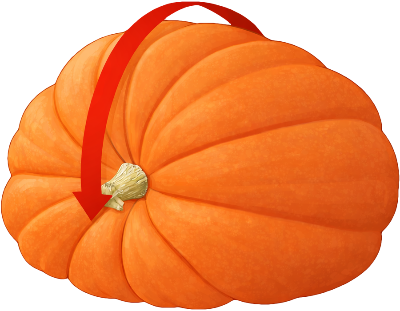
End to End
Over the top, from stem to blossom
Stand facing the stem of the pumpkin. Place one end of the tape on the ground at the stem end, run it up and over the top of the pumpkin, and straight down to the ground at the blossom end.
This measurement runs along the same line as the vine. Measure from ground to ground and go straight over the top — don't follow the pumpkin's curves down to the soil.
Tip: The blossom end is the bottom of the pumpkin opposite the stem — you'll usually see a small circle or scar where the flower was. If there's a pronounced blossom scar bump, go over the top of it.
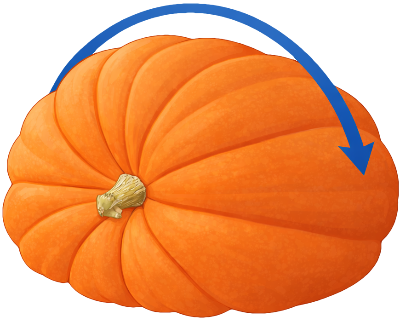
Side to Side
Over the top, perpendicular to the stem
Now rotate 90 degrees so the stem is to your left or right. Place one end of the tape on the ground at the base of the pumpkin, run it straight up the side, over the very top, and straight down the other side to the ground.
The tape should go over the highest point of the pumpkin and be perpendicular to the vine/stem direction. Measure from ground to ground — the tape touches the soil on both sides.
Important: Go straight up and over — do NOT follow the contour of the pumpkin down to the ground. The tape should come off the pumpkin and go straight down to meet the soil.
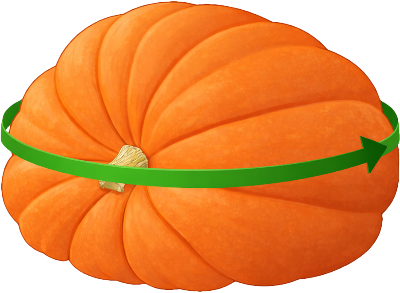
Circumference
The distance around the widest part
Find the widest point of your pumpkin — this is usually at or near stem height. Wrap your tape measure all the way around the pumpkin at this point, keeping the tape parallel to the ground.
The tape should be snug but not tight. You're measuring the outside of the pumpkin, not squeezing it. Make sure the tape doesn't twist or ride up on one side.
Tip: This is usually the largest of the three measurements. For a 1,000 lb pumpkin, expect somewhere around 160–180 inches.
Add them up
Your OTT is simply the sum of the three measurements. That's it.
Example
An OTT of 440 inches estimates to roughly 1,400 lbs on the GPC chart.
Tips for accurate measurements
A few small things that make a big difference in accuracy.
Measure at the same time each day
Pumpkins actually change size slightly throughout the day due to water uptake. Measuring at the same time (morning is best) gives you consistent, comparable numbers.
Keep the tape straight, not curved
For the side-to-side and end-to-end measurements, the tape should go straight up and over the top. Don't let it follow the pumpkin's shape down to the ground — that would add extra inches and throw off your estimate.
Record every measurement
Write down all three numbers each time you measure, not just the OTT total. Tracking the individual measurements helps you understand how your pumpkin's shape is changing — is it getting taller? Wider? Longer?
Be gentle with the tape
Giant pumpkin skin scratches easily, and scratches can become entry points for disease. Lay the tape gently — no dragging, no pulling. Treat the pumpkin like the fragile giant it is.
OTT is an estimate, not gospel
OTT estimates are typically within plus or minus 5% of actual weight, but every pumpkin is different. Wall thickness, density, shape, and how much water it's holding all affect the real weight. Some pumpkins "go heavy" (weigh more than the estimate) and some "go light." You won't know for sure until it hits the scale — and that's half the fun.
Got your measurements?
Plug your numbers into our calculator for an instant weight estimate, or look them up on the OTT chart.