Why Cucumber Beetles Matter More Than You Think
Cucumber beetles are small, but the disease they carry is a giant pumpkin killer. While the beetles themselves cause moderate feeding damage to leaves and flowers, the real threat is bacterial wilt (Erwinia tracheiphila). The bacteria live in the beetles' gut and are transmitted when they feed on your plants. Once bacterial wilt infects a pumpkin plant, there is no cure — the plant will wilt progressively and die. Your entire season can end from a single infected beetle visiting a young transplant.
Identification
There are two species you'll encounter:
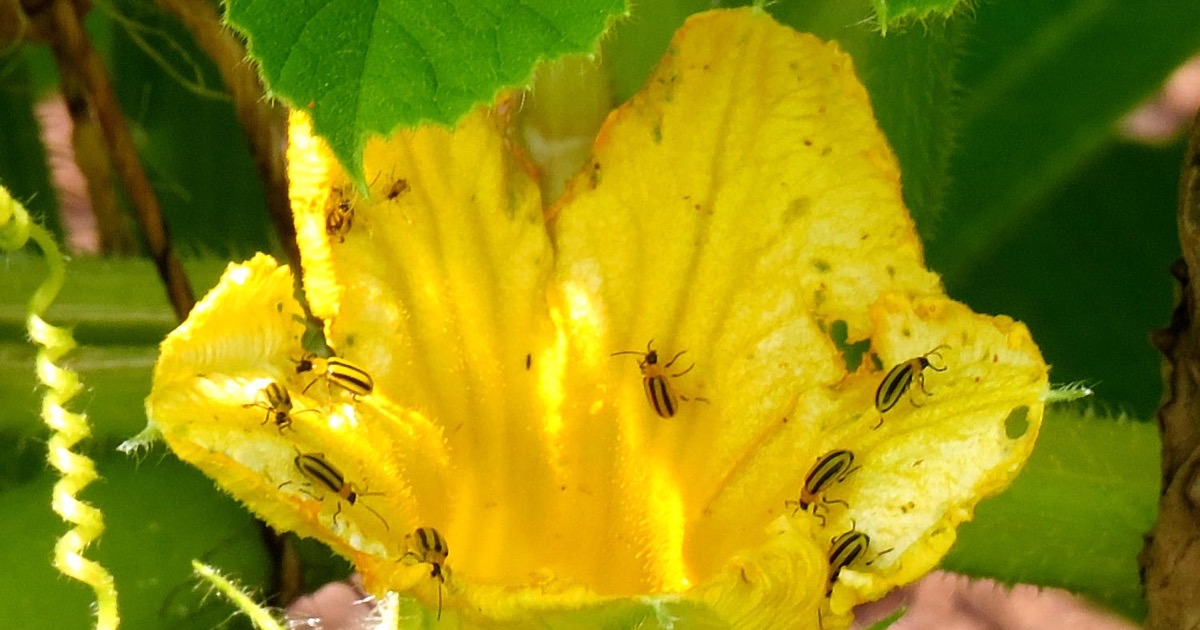
- Striped cucumber beetle: About 1/4 inch long, yellow body with three distinct black stripes running lengthwise. This is the more common species and the primary vector for bacterial wilt.
- Spotted cucumber beetle: Same size, yellow-green body with 12 black spots. Also transmits bacterial wilt but is somewhat less common in northern growing regions.
Both species are strong fliers and can find your plants quickly after transplanting. They're attracted to cucurbitacins — the bitter compounds in cucurbit plants.
The Critical Window
Your plants are most vulnerable to bacterial wilt infection before they develop 4-5 true leaves. Young, tender tissue is more easily infected, and small plants can't tolerate even minor feeding damage. After plants are well-established with thick vines and robust root systems, they can better withstand both beetle feeding and disease pressure — though they're never fully immune.
This means the first 2-3 weeks after transplanting are the highest-risk period. Concentrate your protection efforts here.
One mitigating factor: Atlantic Giants (Cucurbita maxima) are somewhat less susceptible to bacterial wilt than C. pepo species (like zucchini and most small pumpkins). However, this does not make them immune — bacterial wilt can and does kill Atlantic Giants, especially young plants. Don't let reduced susceptibility lull you into complacency.
Scouting
- Scout at least twice weekly on young plants, daily if possible
- Check early morning when beetles are less active and easier to spot
- Look for beetles on leaves, flowers, and at the base of stems
- Watch for feeding damage: small, round holes in leaves and scarring on stems
1 beetle per plant
Action threshold before the 5-leaf stage — even a single beetle warrants immediate action
Prevention
- Transplant larger seedlings: Start your plants indoors and transplant once they have 3-4 true leaves. This shortens the vulnerable window in the field.
- Row covers: Cover transplants immediately with floating row covers. Keep them on until plants need pollination or have outgrown peak vulnerability (5+ true leaves).
- Mulching: Heavy mulch around plants can reduce beetle access to the soil surface where they feed and lay eggs.
- Crop rotation: Beetles overwinter in soil near previous cucurbit plantings. Rotating your patch location helps break the cycle.
- Trap crops: Blue Hubbard squash is highly attractive to cucumber beetles. Plant it on the perimeter to draw beetles away from your main plant.
Treatment
- Hand-picking: Drop beetles into a cup of soapy water. Most effective in early morning when beetles are cold and sluggish. Check your plants daily during the critical early-season window.
- Yellow sticky traps: Place near plants to monitor and reduce beetle populations. Won't eliminate an infestation but helps with early detection.
- Neem oil: Acts as a feeding deterrent. Apply to foliage every 7-10 days during the critical window. Not a knockdown killer, but reduces feeding pressure.
- Kaolin clay (Surround WP): Creates a physical barrier on leaf surfaces that deters feeding. Needs reapplication after rain.
- Pyrethrin: Effective knockdown spray for heavy infestations. Apply in evening to minimize impact on beneficial insects.
Systemic Chemical Protection
For competitive growers, systemic insecticides are the most common and effective tool for cucumber beetle management — and this approach is almost entirely absent from organic-only recommendations:
- Imidacloprid (soil drench): Applied at the base of the plant at or shortly after transplanting. The plant absorbs it through the roots, providing systemic protection that kills beetles when they feed. This is arguably the single most common chemical control used by competitive giant pumpkin growers for early-season beetle protection
- Carbaryl (Sevin): Effective contact spray for heavy infestations. Apply to foliage in the evening. Broad-spectrum — will also kill beneficial insects
- Bifenthrin: Long-residual contact insecticide. Effective as a foliar spray during the critical early-season window
If a plant does develop confirmed bacterial wilt, remove and destroy it immediately. Infected plants serve as a reservoir — beetles feeding on a wilting plant pick up the bacteria and carry it to healthy plants. There is no treatment for bacterial wilt once established.
Cucumber beetles are just one threat to manage. Also see our guides on vine borers, squash bugs, and secondary pests, and build a regular scouting program to catch problems early.