
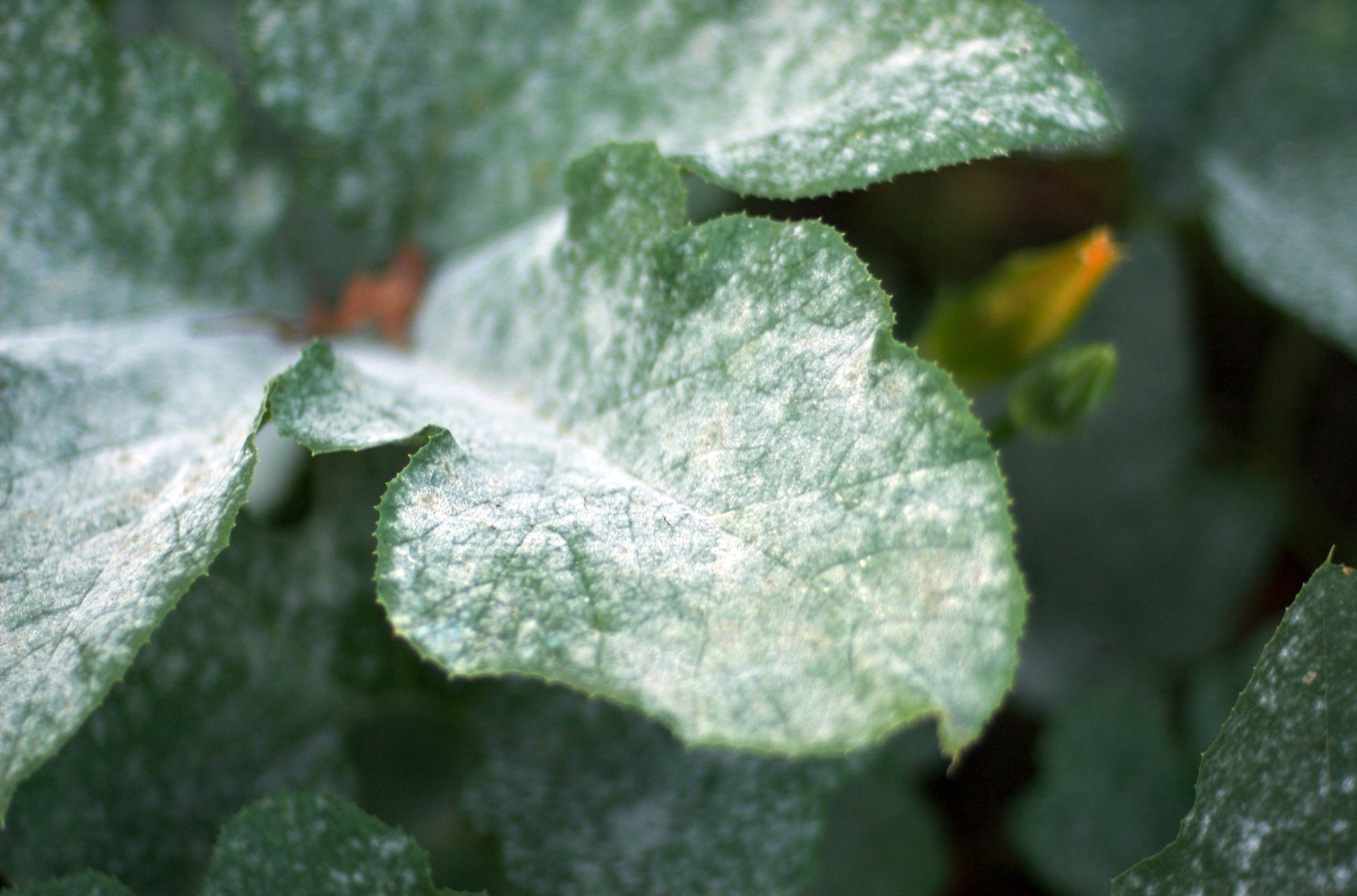
What It Looks Like
Powdery mildew is unmistakable once you've seen it: white to grayish powdery spots on the upper surfaces of leaves, which quickly spread to cover entire leaf surfaces, petioles, and stems. In advanced cases, leaves turn yellow, then brown, and die.
The causal agents are usually Podosphaera xanthii or Erysiphe cichoracearum — both are obligate parasites that only grow on living plant tissue. Unlike many fungal diseases, powdery mildew does not need free water on the leaf surface to infect. Spores germinate best in dry air with moderate temperatures.
Don't confuse powdery mildew with downy mildew, which is a different disease requiring different treatment. Powdery mildew appears as white powder on the upper leaf surface. Downy mildew produces angular, yellowish lesions on the upper surface with grayish-purple sporulation on the underside of leaves, and it requires free moisture to infect.
Why It Matters for Giant Pumpkins
Powdery mildew doesn't attack the fruit directly, but it's devastating in a more insidious way: it destroys the leaf canopy. And for giant pumpkins, leaves are everything.
30–50+ lbs/day
Peak daily weight gain driven by the full leaf canopy — every leaf lost to mildew directly reduces this number
- Defoliated plants go into survival mode, stopping fruit growth and pulling nutrients from the pumpkin back into the vine
- Late-season mildew outbreaks (August–September) are the most damaging because they hit right when the pumpkin is in its peak growth phase
30–40% canopy loss = hundreds of lbs lost
A plant losing this much canopy to mildew can lose hundreds of pounds of potential weight at the scale
Risk Factors
Understanding the conditions that favor powdery mildew helps you prevent it:
- Warm days, cool nights: The classic pattern is daytime temperatures of 68–86°F followed by cooler nights. This temperature swing creates conditions ideal for spore production
- High humidity (but dry leaves): Humidity above 50% at the leaf surface promotes germination, but unlike downy mildew, powdery mildew actually spreads faster on dry leaves
- Poor air circulation: Dense canopies with overlapping leaves create stagnant air pockets where humidity builds
- Shaded leaves: Lower leaves shaded by the canopy are typically first to show symptoms
- Excess nitrogen: Soft, lush growth from over-fertilization is more susceptible than hardened tissue
Prevention
Prevention is always more effective and cheaper than treatment. Build these practices into your growing routine from day one:
- Proper spacing: Don't crowd plants. One plant per 1,000+ square feet gives the canopy room to breathe
- Vine training: Keep vines trained outward in an organized pattern. Overlapping vines create disease-friendly microclimates
- Prune selectively: Remove tertiary vines and any ground-hugging leaves that are shaded by the upper canopy. Improved airflow is your best passive defense
- Water at the base: Use drip irrigation or soaker hoses. Overhead watering doesn't cause powdery mildew (it actually inhibits it temporarily), but wet foliage invites other fungal problems
- Moderate nitrogen: Avoid pushing excessive nitrogen, especially in mid and late season. Slightly harder leaf tissue resists infection better
Organic Controls
If you prefer to avoid synthetic fungicides, several organic options are effective, especially when applied preventively or at the very first sign of infection:
- Potassium bicarbonate: Mix 1 tablespoon per gallon of water with a few drops of liquid soap as a surfactant. Raises leaf surface pH, making it inhospitable to mildew spores. Apply every 7–10 days
- Neem oil: Works as both a preventive and mild curative. Mix according to label directions and spray every 7–14 days. Apply in the evening to avoid leaf burn
- Milk spray: A 40% milk to 60% water solution has been shown in field studies to reduce powdery mildew by 50–70% compared to untreated controls. The exact mechanism isn't fully understood, but the proteins and sugars in milk appear to create conditions hostile to mildew. Best used as part of a broader program rather than as a standalone control. Apply every 7–10 days in the morning
- Bacillus subtilis (sold as Serenade or similar): A biological fungicide that colonizes the leaf surface and outcompetes mildew. Use as a preventive
- Potassium silicate (silicon): Foliar applications of potassium silicate harden leaf tissue and create a physical barrier that resists mildew penetration. Widely used by competitive growers as a supplement alongside other controls. Apply every 7–14 days
Chemical Controls
When organic methods aren't enough — or when you're protecting a competitive pumpkin worth months of work — synthetic fungicides offer stronger protection. The key principle is rotation: never use the same mode of action more than twice in a row, or the mildew will develop resistance.
Most competitive growers rely on synthetic fungicides as their primary line of defense, supplemented by organic options. Common fungicide classes:
- Triazoles, FRAC Group 3 (myclobutanil / Rally, Immunox; propiconazole / Banner MAXX): Systemic — absorbed into the plant. Good curative action on existing infections
- Strobilurins, FRAC Group 11 (azoxystrobin / Quadris; trifloxystrobin / Flint): Locally systemic. Excellent preventive action, but resistance develops quickly — strict rotation required
- Chlorothalonil, FRAC Group M05 (Daconil, Bravo): Contact protectant with broad-spectrum activity. Low resistance risk due to multi-site mode of action. Good rotation partner for Groups 3 and 11
Note: difenoconazole (Revus Top) is also a FRAC Group 3 triazole — do not use it in the same rotation slot as myclobutanil or propiconazole, as they share the same mode of action and rotating between them provides no resistance management benefit.
Product availability varies by region and jurisdiction. Always check local regulations before purchasing or applying any fungicide.
Spray Timing & Schedule
The best spray program in the world fails if the timing is wrong. Follow this schedule:
Start preventive sprays early
Spray every 7–10 days
Increase frequency during high-risk periods
Spray in the morning
Reapply after rain
Many growers save time by tank mixing their fungicide sprays with foliar feeds (fish/seaweed, calcium, micronutrients) in a single pass. Check product labels for compatibility before mixing — some combinations can cause phytotoxicity or reduce effectiveness.
Get thorough coverage: spray the tops and undersides of leaves. Many growers miss the undersides, which is exactly where mildew colonies first establish.
Late Season Management
August and September are the critical months. The pumpkin is gaining its most weight, but the plant is also aging and becoming more susceptible. Late-season management is about keeping the canopy functional as long as possible.
- Don't reduce spray frequency late in the season — if anything, increase it
- Remove heavily infected leaves that are already more than 50% covered — they're no longer photosynthesizing effectively and are just producing more spores
- Focus sprays on the newest, healthiest leaves near the growing tips and around the fruit. These leaves contribute the most to fruit growth
- Continue calcium and potassium foliar feeds alongside fungicide sprays — healthy, well-nourished tissue resists infection better
In the final 2–3 weeks before harvest, focus your sprays on protecting leaves nearest the fruit and the fruit's stem. At this point, preserving the entire canopy is a losing battle in a bad mildew year — concentrate your resources where they matter most for getting the pumpkin to the scale.
Even in a bad mildew year, a well-managed spray program can preserve enough canopy to keep the pumpkin growing through harvest. The difference between a grower who sprays consistently and one who doesn't can easily be 200–400 pounds of fruit weight at the scale.
Powdery mildew is just one piece of the puzzle. Build mildew management into your overall pest scouting program alongside monitoring for vine borers, squash bugs, and secondary pests.